
Realigning Realignment
Let's Fix College Football

Like many across the country, the latest round of realignment has left me cold. Well, I guess it’s not so much the latest round as it is the last 10-15 years. While it’s been cool to see Texas A&M compete in the SEC, it hasn’t always felt right. Now that Texas and Oklahoma are joining the SEC will that help? I don’t know. My college football reptile brain longs to see those three playing Nebraska every year. Nebraska, of course, is in the Big Ten where they now have a heated rivalry with *checks notes* something called “Bowl Eligibility”.
In spite of that uneasy feeling you must admit that, at times, realignment has felt fun. However, the novelty of those new matchups is the shiny toy that the suits hang in front of us while they slowly strip away the best parts of the sport. I’m from the South and college football fandom is an heirloom around here. My grandfather attended the University of Florida and that fandom got passed down. I grew up in an SEC loving household. One of my favorite things about the SEC is all the stadiums and gameday atmospheres. What was so fun as a kid was that you could experience all the stadiums by jumping in the car and having a good old-fashioned family road trip. You didn’t need to hop on a plane to see your team on the road. I don’t imagine we will be getting a lot of USC fans making the 40 hour 2,500 mile drive to see the White Out at Penn State.
Driving to away games, even just going to away games, helps breed more familiarity with your conference mates. I’ve seen the Bear Bryant museum in Tuscaloosa, I got to walk through the Cockabooses at South Carolina, I got drinks thrown on me from the upper deck at LSU. These are the types of experiences that fans will miss when all they are told to care about is the great slate of home games they have now that the conference has new membership. A dad and his son can’t go on a whim to see Ohio State play at USC, but they can make the 3.5 hour drive from Columbus to Purdue.
The sport must get back to its regional roots. Oregon and Oregon State have been playing since 1894. There’s a distinct possibility that Oregon will have to give up that game so they can play Rutgers and Maryland in alternating years. This is dumb. But have no fear, I have decided to fix the problem.
The solution is simple. We climb in our DeLorean and turn the clock back a little. Some conferences will go back to their pre-realignment roots while others will be amalgamations of previous conferences with some current contextual updates. These conferences will be initially considered football only, as some schools, like a UConn, probably have higher aspirations for their basketball team. We are taking the recommendation of the Knight Commission and splitting FBS football away from the NCAA. No other sports need be affected.
In 2023, there will be 133 teams playing FBS football. We will let Notre Dame maintain their independent status (even though it will make scheduling a little tough for them) and divide the other 132 teams into 12 conferences of 11. Each team will play 10 conference games. Each team in the conference will play every conference opponent every year. Conferences can choose to have a conference championship game or go by the regular season standings.
Each team will begin the season with an exhibition game. They can do with this whatever they like, but would be encouraged to play those traditional “buy games”. FCS and smaller FBS teams could still get a much needed check and each team would get that chance to play more people on their roster. This would not only give coaches a better venue to judge their team than a practice, but it would also lessen the amount of plays being endured by the team’s starters.
In addition to this exhibition at the beginning of the season each team will get one out of conference game. You can play whoever you want, whenever you want.
At the end of the season there will be a 16 team playoff and bowl games. Players will get paid to play in bowl games and due to the lack of out of conference games this could go back to being about seeing fun new matchups in historic venues. Speaking of, no more corporate names in bowl games. Corporate sponsors can present the bowl games. It would now be the Independence Bowl presented by Poulan Weed-Eater.
The playoff would consist of the champion from every conference and 4 at large teams. The first three rounds will be played on the campus of the higher seed, and the final will be played at a neutral site.
So now every team would have a chance to win a national championship if they win all their games. That’s never been a possibility before in college football.
You may be asking well what would the conferences look like and how would we fix the TV revenue gap? Well in this plan those two go hand in hand. First let’s take a look at the conferences.
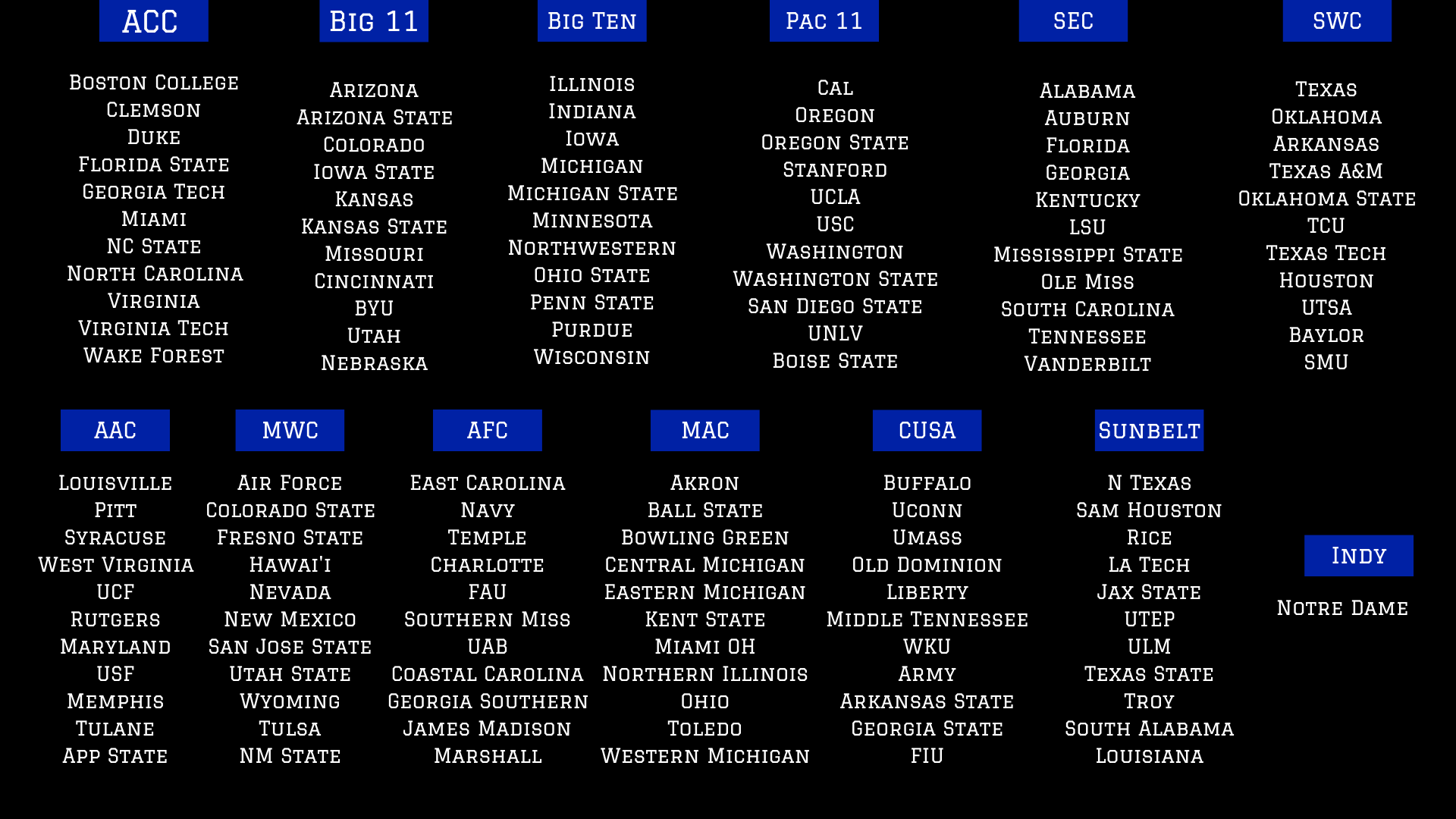
We’ve gone back to some semblance of tradition while trying our best to maintain regionality. Most rivalries will remain in conferences, but one’s that aren’t can be scheduled as the OOC game.
To try to minimize the TV gap we will do two things. All playoff TV revenue will be split evenly among the conferences. The conferences are then allowed to seek out their own TV contracts, but they must do so in groups. Each group will have a tier one conference and a tier two conference. So for example, the ACC and the AAC will sell their television rights together. The revenue split will be decided between the conferences. The schools in the MAC each make about 600k annually off their tv deal. If you gave the whole conference just one of the Big Ten’s projected $80 million shares, I think they would be just fine with that. TV deals will be no longer than 5 years and conferences are free to switch partners during each negotiation. The only rule is that a tier one conference must negotiate in conjunction with a tier two conference. Tentative conference partners are below.
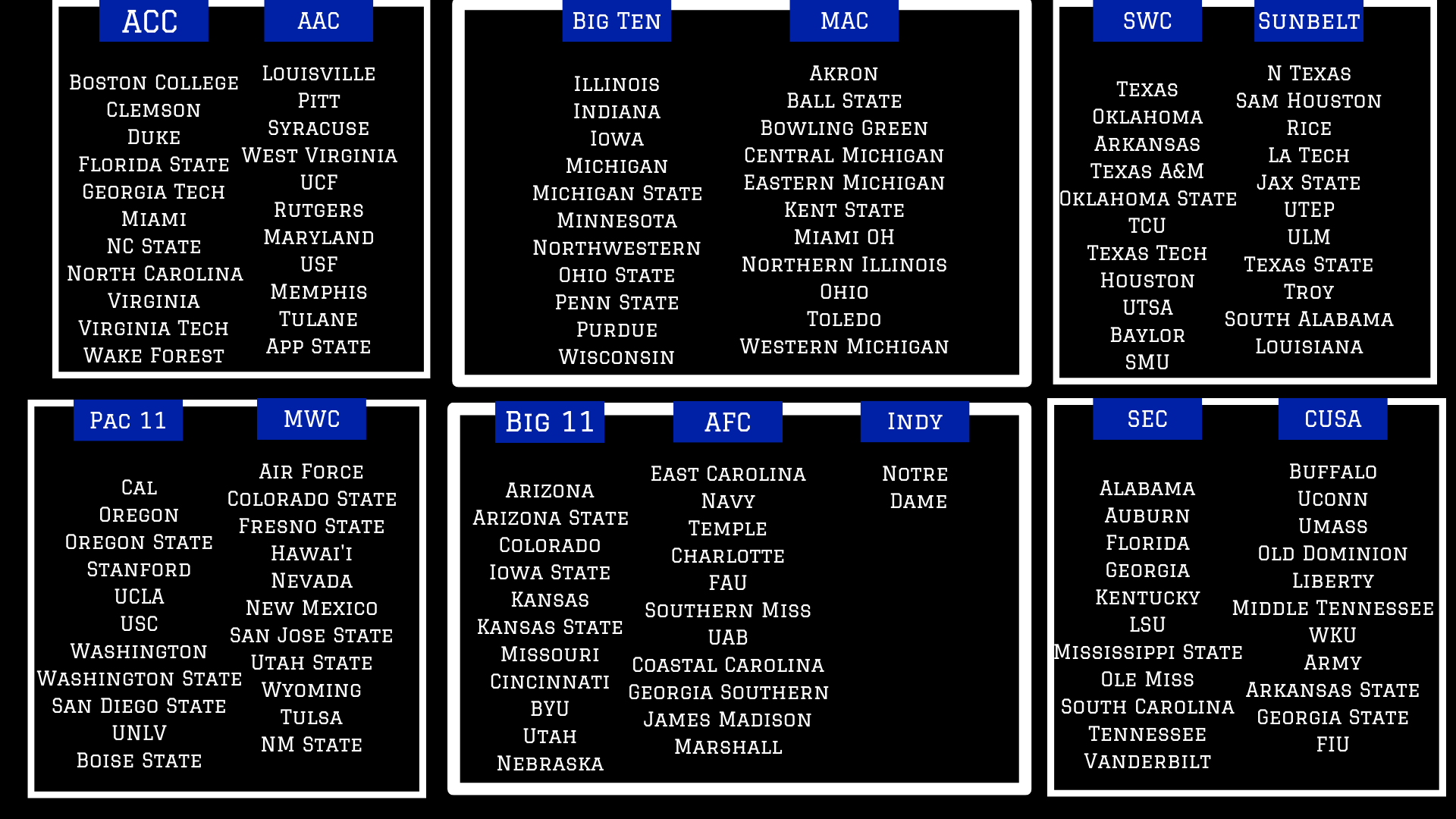
We have regional conferences, the money being spread out a little bit more and everybody has a chance to win a national title. Now let’s talk about athlete compensation.
This new league will involve revenue sharing between the conferences and the players. The split will be something that can be collectively bargained but initially it will be a 75/25 split. Conferences will distribute the amount to the school and the schools will be free to distribute that money to players however they see fit. However, there will be a salary cap of $12 million. All money over that cap will be used to fund a pension. The pension can be accessed after the age of 45 and you must graduate to be vested.
Scholarships will remain but players' tuition cost will be taken out of their salary. This will also encourage a little more regionality as players will have advantages to staying in state. The average in-state tuition at Florida State and Florida is $5,656 and $6,071 respectively. Out of state tuition for Georgia and Alabama is 28,830 and 32,400 respectively. A player from Florida could make a little over $26,000 more per year by staying in state, rather than attending Alabama.
Players also retain their NIL rights as they do now. The only change to the current system is that people representing the business interests of players must be registered with a national clearinghouse. Companies participating in NIL deals with athletes must also register with the clearinghouse. Deal figures do not have to be disclosed and contracts should be somewhat standardized. Any irregularities brought forth by athletes can trigger an audit by a third party CPA into registered representatives or companies.
Now we have a college football system where players can share in the conference revenue, each team has the ability to play for a national championship and regionality is maintained. College football is fixed.
-Seth Varnadore
I like this, and something like the revenue sharing is probably the only way to get stability, regionally based conferences, and sane road trips for non-revenue sports. No doubt I'd tweak some things here or there, but that's not worth a debate at this point. The difficulty, though, with revenue sharing, is being able to coordinate it without running afoul of NCAA vs Board of Regents of University of Oklahoma from 1984, which ended the NCAA's control of football TV rights. I would think that, by having six separate packages, the antitrust issues in that case might be avoided, but that's basically assuming that the schools and conferences involved are all on board with the coordinating body (which wouldn't be the NCAA; they basically don't care about the details of conference membership) and the revenue sharing plan. I could easily see the Big Ten, say, claiming that because they bring far more value than the MAC, they could earn more revenue by bidding separately, and the revenue sharing would be an unfair restraint of trade.
In many ways, it was this court case, and the subsequent decline of the College Football Association formed to sell rights in bulk, that led to the various waves of realignment. Penn State joined the Big Ten in 1990, and Arkansas and South Carolina joined the SEC in 1991. That same year the Big East started sponsoring football, adding Miami (FL) and several football-only members.
Send this to the commissioners and school presidents.